Chemical Reactions and Equations
Chemical Reactions and Equations
Every day, thousands of chemical changes occur around us—milk turning sour, food digesting, rust forming on iron, or a candle burning. These changes where one or more substances are converted into new substances with different properties are called chemical reactions. In a chemical reaction, atoms are rearranged, bonds are broken, and new bonds form, resulting in new products. Chemistry studies these changes to understand how substances behave and transform.
What is a Chemical Reaction?
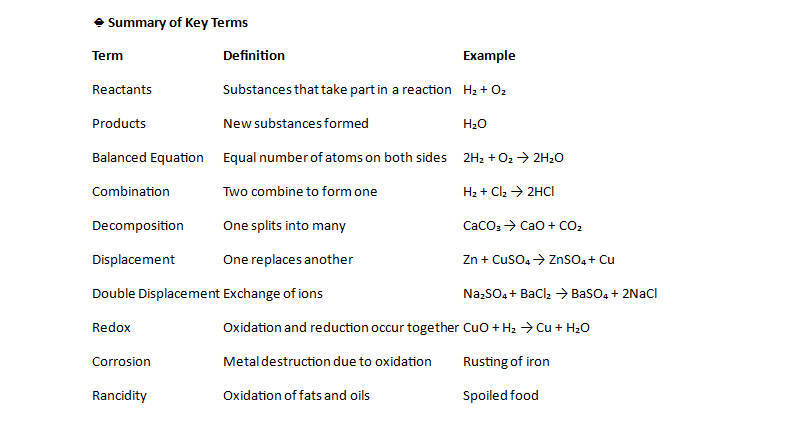
A chemical reaction is a process in which one or more substances (called reactants) convert into one or more new substances (called products).
For example:
Magnesium + Oxygen → Magnesium oxide
When magnesium ribbon burns in air, it reacts with oxygen to form a white powder—magnesium oxide.
Here,
- Reactants → Magnesium and Oxygen
- roduct → Magnesium oxide
Signs of a Chemical Reaction
It is not always possible to “see” atoms changing, but certain observable signs tell us a chemical reaction has occurred:
- Change in State: e.g., solid magnesium burns to form gaseous oxide fumes.
- Change in Colour: e.g., brown iron rusts to reddish-brown ferric oxide.
- Evolution of Gas: e.g., zinc + hydrochloric acid → hydrogen gas.
- Change in Temperature: some reactions release heat (exothermic), others absorb it (endothermic).
- Formation of Precipitate: when two solutions react to form an insoluble solid.
Chemical Equation
A chemical equation is a symbolic representation of a chemical reaction.
It shows the reactants and products with their chemical formulae.
Example:
Magnesium + Oxygen → Magnesium oxide
In symbolic form:
Mg + O2 → MgO
Counting atoms:
- Left: Mg = 1, O = 2
- Right: Mg = 1, O = 1
Not balanced.
To balance, put coefficient 2 before MgO and 2 before Mg:
2Mg + O2 → 2MgO
Now Mg = 2, O = 2 ✅
Steps to Balance a Chemical Equation
- Write the unbalanced equation.
- List the number of atoms of each element on both sides.
- Start balancing with the element that appears in the fewest compounds.
- Balance polyatomic ions (if they appear unchanged).
- Check that all atoms are balanced.
- Verify coefficients are in the simplest ratio.
Example:
Fe + H _2 O →〖Fe 〗_3 O _4+ H _2
Step 1: Fe = 1, H = 2, O = 1 (Left) Fe = 3, O = 4, H = 2 (Right)
Step 2: Balance Fe by putting 3 before Fe:
3Fe +4 H _2 O →〖 Fe 〗_3 O _4+4 H _2
Balanced ✅
Types of Chemical Reactions
1. Combination Reaction
Two or more substances combine to form a single product.
A + B → AB
Example:
2Mg + O _2→2MgO
Energy is released → Exothermic reaction.
2. Decomposition Reaction
A single compound breaks down into two or more simpler substances.
AB → A + B
Types:
• Thermal decomposition: by heat
〖"CaCO" 〗_3 →┴("heat" ) "CaO"+〖"CO" 〗_2
• Electrolytic decomposition: by electricity
2"H" _2 "O" →┴("electricity" ) 2"H" _2+"O" _2
• Photochemical decomposition: by light
2"AgBr" →┴("light" ) 2"Ag"+〖"Br" 〗_2
These reactions help in extracting metals, producing gases, etc.
Prevention:
- Painting, oiling, greasing
- Galvanization (coating with zinc)
- Electroplating
- Alloy formation (e.g., stainless steel)
Rancidity
When fats and oils get oxidized, they develop a foul smell and taste—this is rancidity.
Prevented by
- Keeping food in airtight containers
- Using antioxidants (like BHA, BHT)
- Refrigeration
- Nitrogen flushing in chips packets
Importance of Chemical Reactions
Chemical reactions are the backbone of life and industry:
- Digestion of food in our body
- Photosynthesis in plants
- Combustion of fuels
- Extraction and purification of metals
- Manufacturing of medicines, fertilizers, and plastics
Practical Applications
Electrolysis of water → production of hydrogen and oxygen.
Neutralization reactions → used in agriculture and medicine.
Thermite reaction → used for welding railway tracks:
〖"Fe" 〗_2 "O" _3+2"Al"→2"Fe"+〖"Al" 〗_2 "O" _3+"Heat"
Displacement reactions → extracting metals from ores.
Conclusion
Chemical reactions are at the heart of chemistry. They explain every transformation we observe—whether it’s burning fuel, digesting food, or manufacturing materials. Understanding chemical equations helps us represent these changes precisely and predict how substances behave. Balanced equations not only follow the law of conservation of mass but also help chemists control reactions efficiently for real-world applications.