Coordinate Geometry
Introduction to Coordinate Geometry
Coordinate Geometry is one of the most interesting chapters in Class 10 Mathematics because it connects geometry with algebra. In this chapter, students learn how to locate points on a graph using numbers and calculate distances between points.
Coordinate Geometry helps us understand positions and measurements on a plane. It is widely used in engineering, computer graphics, GPS navigation, architecture, gaming, robotics, and map designing.
In simple words, Coordinate Geometry is the study of geometry using coordinates.
For example, if someone asks for a location on a map, we often use coordinates to find the exact position. Similarly, in mathematics, points are represented using numbers.
This chapter mainly focuses on Coordinate Plane, Cartesian System, Distance Formula, Section Formula, and Area of Triangle.
Understanding these topics properly will make this chapter very easy and scoring in board exams.
What is Coordinate Geometry?
Coordinate Geometry is a branch of mathematics where geometric shapes are studied using numbers and coordinates.
In this system, every point is represented by two numbers called coordinates.
For example:
(3, 5)
Here, 3 represents the horizontal position and 5 represents the vertical position.
These coordinates help us identify the exact location of a point on a graph.
Coordinate Geometry was introduced by the famous mathematician René Descartes. Because of him, the coordinate system is also called the Cartesian Coordinate System.
Cartesian Coordinate System
The Cartesian Coordinate System is formed by two perpendicular lines called axes.
1. X-axis
The horizontal line is called the x-axis.
Right side values are positive while left side values are negative.
2. Y-axis
The vertical line is called the y-axis.
Upper values are positive while lower values are negative.
The point where both axes intersect is called the Origin.
The coordinates of the origin are (0, 0).
This point acts as the starting point of the graph.
Coordinates of a Point
Every point on a graph is represented as:
(x, y)
Where x represents the horizontal distance from the origin and y represents the vertical distance from the origin.
Example
Point (4, 2) means move 4 units to the right and 2 units upward.
Similarly, point (-3, 5) means move 3 units left and 5 units upward.
Learning how to identify coordinates correctly is very important for solving graph questions.
Quadrants in Coordinate Geometry
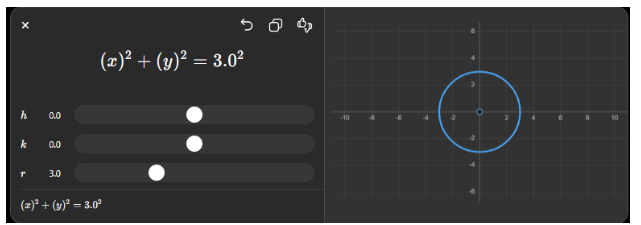
The x-axis and y-axis divide the graph into four parts called quadrants.
First Quadrant
Coordinates are (+, +). Both x and y are positive.
Example: (3, 5)
Second Quadrant
Coordinates are (-, +). x is negative and y is positive.
Example: (-2, 4)
Third Quadrant
Coordinates are (-, -). Both x and y are negative.
Example: (-3, -6)
Fourth Quadrant
Coordinates are (+, -). x is positive and y is negative.
Example: (4, -2)
Students should remember the sign pattern of quadrants because questions are often asked in exams.
Distance Formula
One of the most important topics in Coordinate Geometry is the Distance Formula.
This formula is used to find the distance between two points.
Suppose two points are A(x₁, y₁) and B(x₂, y₂).
Then the distance between them is:
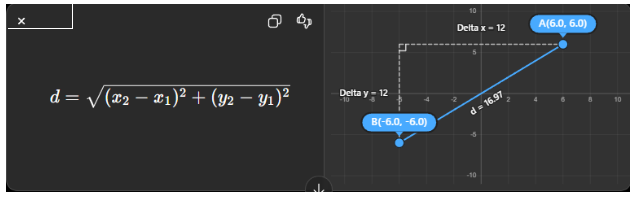
Where:
Find the distance between A(2, 3) and B(6, 6).
Distance = √[(6 − 2)² + (6 − 3)²]
= √[4² + 3²]
= √[16 + 9]
= √25
= 5 units
Therefore, the distance between the two points is 5 units.
Importance of Distance Formula
This formula helps in finding side lengths of shapes, checking whether a triangle is right-angled, and solving geometry-based problems.
It is frequently asked in board exams.
Section Formula
The Section Formula is used to find a point dividing a line segment into a certain ratio.
Suppose point P divides a line joining A(x₁, y₁) and B(x₂, y₂) in the ratio m:n.
Coordinates of P are:
((mx₂ + nx₁)/(m + n), (my₂ + ny₁)/(m + n))
This formula helps calculate the exact midpoint or dividing point of a line segment.
Midpoint Formula
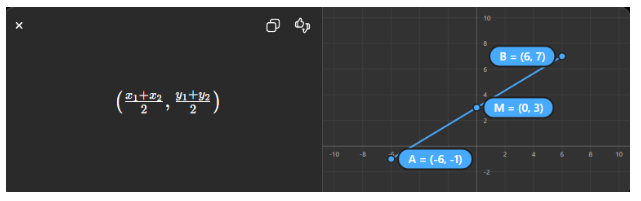
When the ratio is 1:1, the Section Formula becomes the Midpoint Formula.
Coordinates of midpoint are:
Example
Find the midpoint of A(2, 4) and B(8, 10).
Midpoint = ((2 + 8)/2, (4 + 10)/2)
= (10/2, 14/2)
= (5, 7)
Therefore, the midpoint is (5, 7).
This is one of the easiest scoring concepts in the chapter.
Area of a Triangle
Coordinate Geometry also helps us find the area of a triangle using coordinates.
Suppose the vertices are (x₁, y₁), (x₂, y₂), and (x₃, y₃).
Area = 1/2 |x₁(y₂ − y₃) + x₂(y₃ − y₁) + x₃(y₁ − y₂)|
Example
Find the area of a triangle with points A(1, 1), B(4, 5), and C(7, 2).
After applying the formula, the area can be calculated easily.
This concept is useful for solving geometry problems without measuring sides.
Special Case
If the area of three points becomes zero, then the points are called collinear points.
This means all three points lie on the same straight line.
Applications of Coordinate Geometry
GPS and Navigation
Maps and GPS systems use coordinates to locate exact positions.
Computer Graphics
Video games and animation use coordinate systems for designing objects and movement.
Architecture and Construction
Architects use coordinates to create building layouts.
Engineering
Mechanical and civil engineers use coordinate systems for measurements and planning.
Astronomy
Scientists use coordinate systems to locate stars and planets.
This shows that Coordinate Geometry is not only useful in school but also in real-world professions.
Common Mistakes Students Make
1. Writing Coordinates Incorrectly
Always remember the format (x, y). Do not confuse x with y.
2. Sign Mistakes
Negative signs are very important. For example, (-3, 5) is different from (3, -5).
3. Formula Errors
Always write formulas carefully before solving questions.
4. Calculation Mistakes
Square values properly while using the Distance Formula. For example, (-4)² = 16, not -16.
Tips to Score Good Marks in Coordinate Geometry
Learn all formulas properly and practice plotting points on graphs.
Revise quadrant signs regularly and solve NCERT exercises multiple times.
Practice numerical questions daily because Coordinate Geometry is a formula-based chapter.
Regular practice makes it easy to score full marks.
Conclusion
The chapter Coordinate Geometry is one of the easiest and most practical chapters in Class 10 Mathematics. It teaches students how to represent points, measure distances, divide line segments, and calculate areas using coordinates.
Key concepts such as the Cartesian Coordinate System, Distance Formula, Section Formula, and Area of Triangle are important not only for board exams but also for future mathematics.
Once students understand the formulas and practice enough numerical questions, this chapter becomes very easy. Regular revision and solving examples will help build confidence and improve examination performance.