Trigonometry
Introduction to Trigonometry
Trigonometry is one of the most important chapters in Class 10 Mathematics. Many students find this chapter difficult at first, but once the basics are understood, it becomes one of the easiest and highest-scoring topics.
The word Trigonometry comes from Greek words:
Trigonon meaning triangle
Metron meaning measurement
So, Trigonometry simply means the study of measurements related to triangles.
In Class 10, trigonometry mainly deals with the relationship between the angles and sides of a right-angled triangle.
This chapter helps students calculate unknown sides and angles of triangles. Trigonometry is widely used in Engineering, Architecture, Astronomy, Navigation, Construction, Physics, and GPS systems.
In simple words, trigonometry helps us find the height and distance of objects without measuring them directly.
What is Trigonometry?
Trigonometry is a branch of mathematics that studies the relationship between the sides and angles of triangles.
In Class 10, we mainly study right-angled triangles.
A right-angled triangle has:
• One angle equal to 90°
• One Hypotenuse
• One Base
• One Perpendicular
Parts of a Right Triangle
Consider a right triangle:
Hypotenuse → The longest side opposite to the right angle.
Base → The side adjacent to the angle.
Perpendicular → The side opposite to the angle.
Understanding these three terms is very important because trigonometric ratios depend on them.
Trigonometric Ratios
The main concept of trigonometry is trigonometric ratios.
There are six trigonometric ratios.
1. Sine (Sin)
sin θ = Perpendicular / Hypotenuse
2. Cosine (Cos)
cos θ = Base / Hypotenuse
3. Tangent (Tan)
tan θ = Perpendicular / Base
4. Cosecant (Cosec)
cosec θ = Hypotenuse / Perpendicular
5. Secant (Sec)
sec θ = Hypotenuse / Base
6. Cotangent (Cot)
cot θ = Base / Perpendicular
These six ratios are the foundation of trigonometry and students should memorize them carefully.
Easy Trick to Remember Trigonometric Ratios
A common trick to remember the ratios is:
“Some People Have Curly Brown Hair Through Proper Brushing”
This means:
Sin = Perpendicular / Hypotenuse
Cos = Base / Hypotenuse
Tan = Perpendicular / Base
And their reciprocals:
Cosec = Hypotenuse / Perpendicular
Sec = Hypotenuse / Base
Cot = Base / Perpendicular
This trick helps students quickly remember formulas during exams.
Trigonometric Ratios of Standard Angles
Students should learn trigonometric values of common angles:
0°, 30°, 45°, 60°, 90°
Sin Values
sin 0° = 0
sin 30° = 1/2
sin 45° = 1/√2
sin 60° = √3/2
sin 90° = 1
Cos Values
cos 0° = 1
cos 30° = √3/2
cos 45° = 1/√2
cos 60° = 1/2
cos 90° = 0
Tan Values
tan 0° = 0
tan 30° = 1/√3
tan 45° = 1
tan 60° = √3
tan 90° is not defined
These values are extremely important for board examinations.
Relationship Between Trigonometric Ratios
Some identities help connect trigonometric ratios.
Identity 1
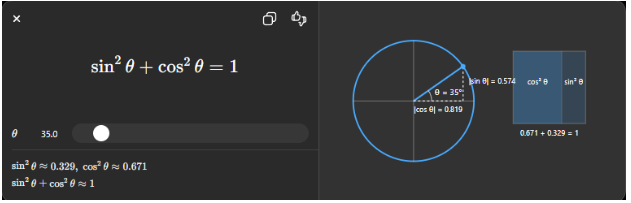
sin2θ+cos2θ=1\sin^2\theta + \cos^2\theta = 1
Identity 2
1 + tan²θ = sec²θ
Identity 3
1 + cot²θ = cosec²θ
These formulas are called trigonometric identities.
They are frequently asked in proof-based questions.
Complementary Angles
Two angles are called complementary if their sum is 90°.
Example:
30° + 60° = 90°
Complementary Relations
sin(90° − θ) = cos θ
cos(90° − θ) = sin θ
tan(90° − θ) = cot θ
These formulas help simplify problems quickly.
Example of Solving a Trigonometry Question
Suppose:
Perpendicular = 6 cm
Base = 8 cm
Find:
Sin θ and Cos θ
First, find the hypotenuse using the Pythagoras Theorem:
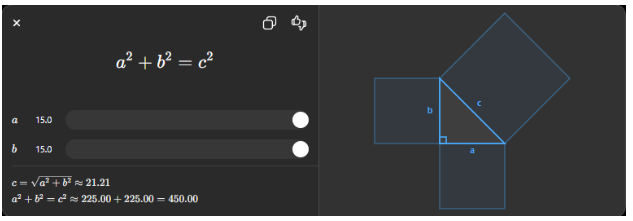
Hypotenuse = √(6² + 8²)
= √(36 + 64)
= √100
= 10 cm
Now:
Sin θ = 6/10 = 3/5
Cos θ = 8/10 = 4/5
Hence:
Sin θ = 3/5
Cos θ = 4/5
Applications of Trigonometry
Measuring Height of Buildings
Using trigonometry, we can find the height of tall buildings without climbing them.
Astronomy
Scientists use trigonometry to measure the distance between stars and planets.
Navigation
Ships and airplanes use trigonometric calculations for direction and location.
Construction
Architects use trigonometry while designing bridges and buildings.
GPS Systems
Maps and navigation systems use trigonometric principles for positioning.
This shows that trigonometry is useful in everyday technology.
Common Mistakes Students Make
1. Confusing Base and Perpendicular
Always identify the angle first before deciding base and perpendicular.
2. Forgetting Standard Values
Learn the values of 30°, 45°, and 60° properly.
3. Identity Mistakes
Remember squares carefully.
sin²θ + cos²θ = 1
Not:
sinθ + cosθ = 1
4. Calculation Errors
Solve square roots carefully and verify calculations.
Tips to Score Good Marks in Trigonometry
Learn all six ratios properly.
Memorize standard angle values.
Practice identities regularly.
Solve NCERT questions multiple times.
Practice numerical problems daily.
Trigonometry becomes easy with regular practice.
Conclusion
The chapter Introduction to Trigonometry is one of the most important topics in Class 10 Mathematics. It teaches students the relationship between the sides and angles of a right triangle using trigonometric ratios.
Key concepts such as sin, cos, tan, standard angle values, identities, and complementary angles are very important for board examinations.
Although many students initially fear trigonometry, it becomes simple once the formulas are understood and practiced regularly. By revising formulas and solving enough questions, students can master this chapter and score excellent marks in examinations.